63.0 - Last modified on 2026-06-11 Revised by Aaron B Reiser
62.0 - Last modified on 2026-05-19 Revised by Aaron B Reiser
61.0 - Last modified on 2026-05-15 Revised by Aaron B Reiser
60.0 - Last modified on 2026-05-15 Revised by Aaron B Reiser
59.0 - Last modified on 2026-05-15 Revised by Aaron B Reiser
58.0 - Last modified on 2026-05-15 Revised by Aaron B Reiser
57.0 - Last modified on 2026-05-15 Revised by Aaron B Reiser
56.0 - Last modified on 2026-05-05 Revised by Scott R. Richardson
55.0 - Last modified on 2025-12-18 Revised by Martha Avila
54.0 - Last modified on 2025-11-24 Revised by Aaron B Reiser
53.0 - Last modified on 2025-11-18 Revised by Aaron B Reiser
52.0 - Last modified on 2025-11-18 Revised by Aaron B Reiser
51.0 - Last modified on 2025-03-24 Revised by Scott R. Richardson
50.0 - Last modified on 2025-06-06 Revised by Sophie Corless
49.0 - Last modified on 2024-07-05 Revised by Scott R. Richardson
48.0 - Last modified on 2024-07-03 Revised by Sophie Corless
47.0 - Last modified on 2024-05-16 Revised by Sophie Corless
46.0 - Last modified on 2024-05-16 Revised by Sophie Corless
45.0 - Last modified on 2024-05-16 Revised by Sophie Corless
44.0 - Last modified on 2023-11-14 Revised by Gary Edward Ward
43.0 - Last modified on 2023-09-29 Revised by Gary Edward Ward
42.0 - Last modified on 2023-09-27 Revised by Gary Edward Ward
41.0 - Last modified on 2023-08-29 Revised by Scott R. Richardson
40.0 - Last modified on 2023-08-16 Revised by Gary Edward Ward
39.0 - Last modified on 2023-08-16 Revised by Gary Edward Ward
38.0 - Last modified on 2023-08-14 Revised by Scott R. Richardson
37.0 - Last modified on 2023-08-14 Revised by Gary Edward Ward
36.0 - Last modified on 2023-08-14 Revised by Gary Edward Ward
35.0 - Last modified on 2023-08-14 Revised by Gary Edward Ward
34.0 - Last modified on 2023-08-14 Revised by Gary Edward Ward
33.0 - Last modified on 2023-08-14 Revised by Gary Edward Ward
32.0 - Last modified on 2023-08-14 Revised by Gary Edward Ward
31.0 - Last modified on 2023-08-11 Revised by Gary Edward Ward
30.0 - Last modified on 2023-08-11 Revised by Gary Edward Ward
29.0 - Last modified on 2023-08-10 Revised by Gary Edward Ward
28.0 - Last modified on 2023-08-10 Revised by Gary Edward Ward
27.0 - Last modified on 2023-08-10 Revised by Gary Edward Ward
26.0 - Last modified on 2023-08-10 Revised by Gary Edward Ward
25.0 - Last modified on 2023-08-10 Revised by Gary Edward Ward
24.0 - Last modified on 2023-08-10 Revised by Gary Edward Ward
23.0 - Last modified on 2022-10-19 Revised by Gary Edward Ward
22.0 - Last modified on 2022-10-19 Revised by Gary Edward Ward
21.0 - Last modified on 2022-08-31 Revised by Gary Edward Ward
20.0 - Last modified on 2022-04-21 Revised by Aaron B Reiser
19.0 - Last modified on 2021-11-15 Revised by Aaron B Reiser
18.0 - Last modified on 2021-11-02 Revised by Aaron B Reiser
17.0 - Last modified on 2020-12-15 Revised by Aaron B Reiser
16.0 - Last modified on 2020-08-18 Revised by Aaron B Reiser
15.0 - Last modified on 2020-08-12 Revised by Aaron B Reiser
14.0 - Last modified on 2020-08-05 Revised by Aaron B Reiser
13.0 - Last modified on 2020-07-06 Revised by Gary Edward Ward
12.0 - Last modified on 2020-07-01 Revised by Aaron B Reiser
11.0 - Last modified on 2020-06-30 Revised by Gary Edward Ward
10.0 - Last modified on 2020-06-15 Revised by Aaron B Reiser
9.0 - Last modified on 2020-06-12 Revised by Scott R. Richardson
8.0 - Last modified on 2020-06-12 Revised by Scott R. Richardson
7.0 - Last modified on 2020-06-12 Revised by Gary Edward Ward
6.0 - Last modified on 2020-05-12 Revised by Aaron B Reiser
5.0 - Last modified on 2020-05-11 Revised by Aaron B Reiser
4.0 - Last modified on 2020-05-08 Revised by Aaron B Reiser
3.0 - Last modified on 2020-05-07 Revised by Aaron B Reiser
2.0 - Last modified on 2020-05-01 Revised by Aaron B Reiser
1.0 - Created on 2020-05-01 Authored by Aaron B Reiser
Multi-Factor Authentication (MFA):
Getting Started |
|
What is Multi-Factor Authentication (MFA)?
Why am I being asked to complete MFA?
Available Authentication Methods
Registration Steps for New Users
Registering Other Devices
|
What is Multi-Factor Authentication (MFA)?
Authentication is the process by which a system determines that you are who you claim to be.
There are multiple factors of authentication, which can be broken down into categories like such:
- Something you know, such as a password.
- Something you have, such as your mobile phone.
- Something you are (i.e., biometrics), such as your fingerprint.
When you use more factors of authentication, the system can be more confident that you are who you claim to be, leading to better security.
For example, your password might be comprised when a web site gets hacked, but with multi-factor authentication that password is useless without your mobile phone.
Why am I being asked to complete MFA?
To better protect the security of your online information, the university has implemented MFA using the Duo product. This system will come up when you log into any university web application protected by MFA.
Before you can complete the authentication process, you will need to enroll a device. The recommended device is a smartphone or tablet, such as an iPhone or Android device.
If you have not enrolled a device please follow the instructions below. You will need your chosen device handy to complete this process.
Available Authentication Methods
| Method |
Description |
| Duo Push |
Pushes a request to your phone or tablet (if you have the Duo Mobile application installed and activated on your iOS, Android, or Windows Phone device). Just review the request and tap Approve. |
| Call Me |
Receive a phone call and follow the instructions. |
| Enter a Passcode |
Enter a passcode, generated with the Duo Mobile application, sent to you via SMS text, or generated by your hardware token. Click Send codes to get a new batch of passcodes texted to your phone. |
| Use Touch ID |
In order to use Apple Touch ID, make sure you have the following:
|
| Use Security Key |
Authenticate with a touch of a button (no passcode needed).
The generic term is "security key" and one example is the YubiKey, a product made by YubiCo.
- Specifically configured security keys for the university's MFA service can be purchased at the Campus Computer Store.
- Product information is available at: https://www.yubico.com/.
Note regarding security keys:
- Security keys sold by the Campus Computer Store are configured for the university's MFA service and are incompatible with the YubiCloud OTP validation infrastructure.
- Not consistently supported in Chrome (known to work in Edge, Firefox, and Safari).
- Some models do not work with UTLogin - a good reason to have multiple authentication methods.
|
Registration Steps for New Users
The first step in registration is to enroll your device using your UT EID.
The device you enroll will be used when you are prompted to authenticate by university web applications protected by MFA (e.g., Workday).
The instructions below will guide you through the setup.
1. Click HERE to go to the Self-Registration Portal.
2. Sign on with your UT EID and EID password.
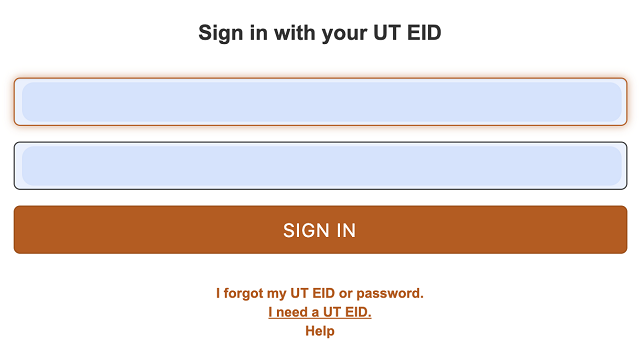
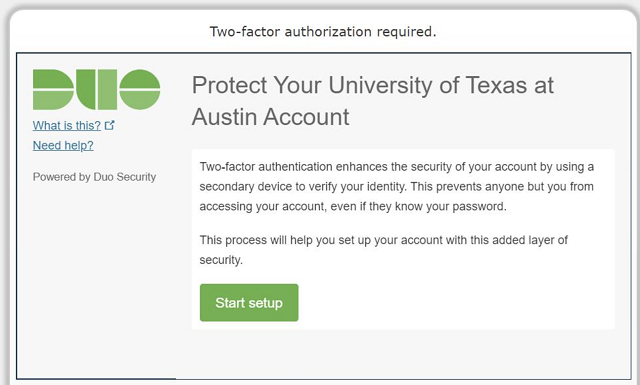
3. Select the "Start Setup" button.
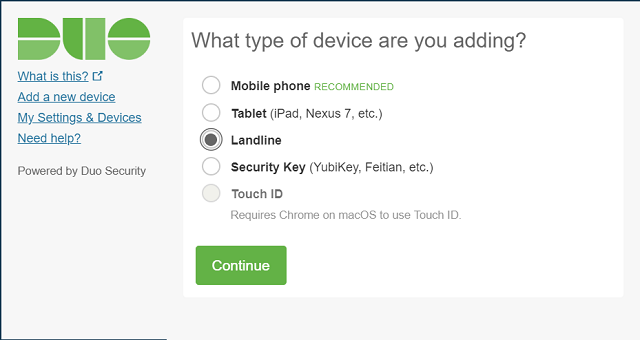
4. Next, select "Mobile Phone" or "Landline".
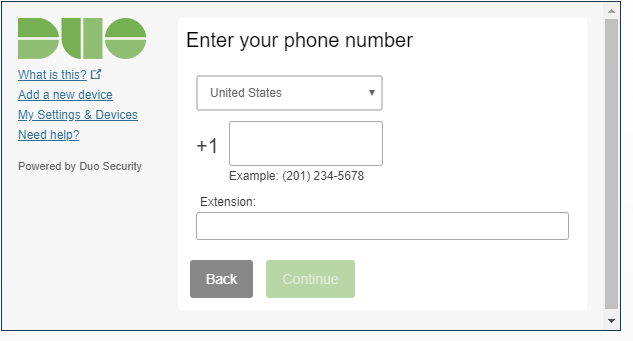
5. Input your number, verify that it is correct, and hit continue.
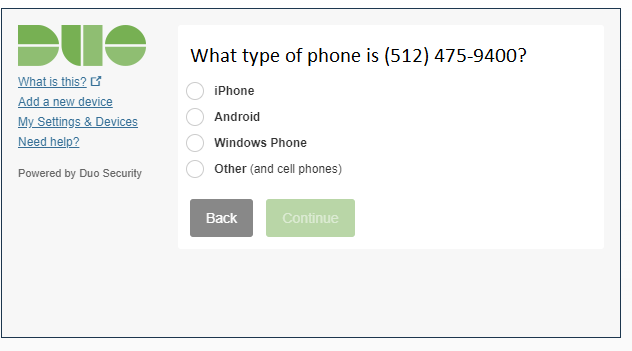
6. If you chose "landline" you are all setup and ready to go. If you chose "mobile phone," specify your device type and hit continue.
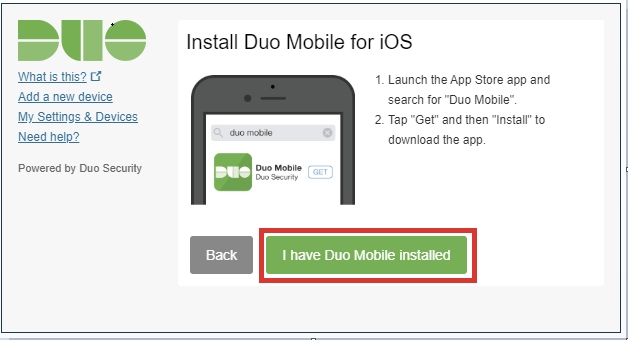
7. If you already have the Duo Mobile application installed on your phone, select "I have Duo Mobile Installed".
- If you have not installed the Duo Mobile application, select that option.
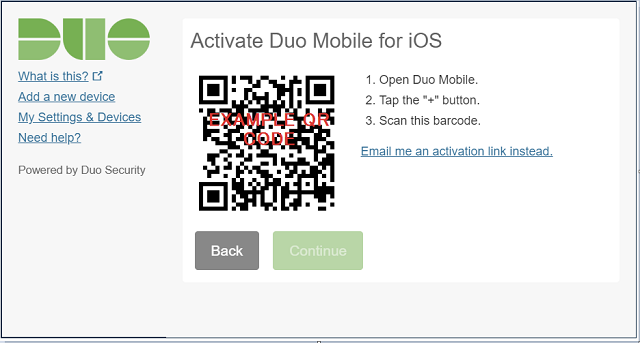
8. A QR code will appear. Open Duo Mobile. Tap the "+" button. Scan the QR code on the screen.
Registering Other Devices
For help registering other devices with Duo, please visit our Device Management article in the link below: